The sun is just starting to crack the horizon, painting the sky in shades I haven’t seen since last winter. Under my feet, the frozen lake lets out a deep, groaning creak—a sound that tells you you’re standing on something alive. This is the world of ice fishing, and if you think it’s about a lone figure shivering over a hole in silent misery, I’m here to tell you that picture is completely wrong.
Forget the lonely caricature. The truth is, life on the hard water is one of the most engaging, social, and thrilling experiences winter has to offer. It’s a pastime built on community, a healthy respect for nature’s science, and heart-pounding moments you’d never expect. Let me pull back the curtain and show you what it’s really like out here.
Listen to our complete podcast:
1. It’s a Social Gathering, Not Solitary Confinement
Contrary to its solitary image, ice fishing is intensely social. In fact, I’ve found that ice fishermen are the friendliest subset of anglers out there. Unlike super-secret surfcasters or territorial boat fishermen, folks on the ice are an outgoing bunch, always ready to share information, tell jokes, and offer solid advice. It’s less about quiet contemplation and more about camaraderie, with groups turning a frozen lake into a sprawling winter block party.
This festive atmosphere is best embodied by the “ice camp”—a temporary village dedicated to having a good time. It’s where the thrilling action of fishing blends with pure, unadulterated fun. One minute you’re grilling venison and passing around jerky, and the next, someone yells the magic words. A flag has popped on a tip-up across the ice, and the entire camp erupts. It’s a frenzied, full-contact race to the hole, a beautiful foot-first slide across the slick surface to see who can get there first. This shared excitement is what it’s all about.
A proper “ice camp” contains the following: a portable propane grill, manly food like venison, Pringles, jerky and doughnuts, folding chairs, a couple of dogs, a cooler (to keep beer warm, not cold), hockey sticks, a small fire, a radio (in case you want to dance), and a football.
This community spirit is perhaps the most shocking and appealing part of the sport. It transforms a simple hobby into a cherished social tradition, proving that the best way to beat the cold is with good company and a little friendly competition.
2. Safety Isn’t Just a Suggestion—It’s a Science
While it might look like a casual day out, ice fishing is underpinned by a meticulous and scientific approach to safety. For those of us who live for this sport, understanding the ice isn’t guesswork; it’s the single most critical aspect of what we do, and we treat it with the precision it deserves.
There are hard-and-fast rules about ice thickness that are never ignored. Before anyone steps foot on a frozen lake, we ensure it meets strict safety minimums. The gold standard isn’t just about depth, but the type of ice.
- A solid 4 inches of clear, black ice is the widely accepted minimum for walking. Not all ice is created equal, and this strong, clear ice is what you’re looking for.
- Many of us won’t venture out on anything less than 5 inches just to be extra safe.
Confirming these conditions is a systematic process. We’ll call local bait shops for the latest reports, and once on-site, we actively test the ice thickness every 10 to 20 yards with an auger or a chisel. We’re also trained to identify and avoid weaker spots, like areas near moving water from streams or around submerged trees that absorb sunlight and thin the ice from below.
This careful preparation extends to our gear. For the experienced, certain safety items are non-negotiable and might surprise a newcomer with their specificity.
- Ice Picks: Handheld spikes designed to give you the grip needed to pull yourself out of the water if you fall through.
- Traction Cleats: These slip over your boots to give you a solid grip and prevent dangerous falls on slick, clear ice.
- Flotation Gear: Modern ice fishing bibs often have flotation material built right in. If not, an inflatable lifejacket is considered an essential piece of kit.
This methodical focus on safety reveals a deeper truth about the sport: it’s about preparation, knowledge, and a profound respect for the power of nature, not reckless adventure.
3. You Fish With Traps as Much as With Rods
If your only image of fishing involves actively holding a rod, ice fishing has a major surprise in store for you: the tip-up. While jigging with a small rod is definitely part of the sport, the primary tool for many of us is this ingenious, trap-like device that does the fishing for you.
A tip-up is a simple mechanism that sits over a hole in the ice, with a spool of line submerged at a set depth. When a fish takes the bait, it trips a trigger, and a brightly colored flag springs into the air, signaling a bite from hundreds of feet away.
The real advantage is that regulations in many states allow an angler to use multiple lines at once. By setting out a spread of tip-ups, you can cover a huge area, test various depths, and dramatically increase your chances of a catch. It turns fishing from a passive wait into an active, strategic hunt. And when a flag finally pops, the quiet day erupts into a moment of pure adrenaline.
“FLAG UP!”
The second we hear that yell, it’s an all-out sprint to the hole. Trust me, you’ve never run so fast on ice in your life. This method is more like running a trapline than traditional fishing. You get to the hole, grab the main line, and fight the fish “bare-knuckled,” pulling it in hand over hand without a reel. The excitement of racing across the ice to that sprung flag and feeling the raw power of the fish through the line is a unique thrill that hooks anglers for life.
4. Getting Started Can Be Surprisingly Affordable
One of the biggest myths about any new outdoor hobby is that it requires a massive, upfront investment. While you can certainly spend a fortune, the barrier to entry for ice fishing is surprisingly low. The absolute best way to start? Don’t buy a thing.
Seriously. The number one piece of advice for any beginner is this: “Get a permit, go with a friend for free.” Bundle up in the winter coat and boots you already own, borrow some gear, and see if you enjoy the experience before spending a dime.
If you don’t have a friend to take you, a minimalist setup is incredibly cheap.
- A used hand auger (for drilling holes)
- A couple of inexpensive rod/reel combos (some go for around $11)
- A lead depth finder sinker and some slip bobbers
- Small hooks and bait, like wax worms
If you get hooked, the sport scales with your interest. You can gradually upgrade to a portable shelter, a heater, and fish-finding electronics. And if you truly get the bug, that path could eventually lead to a fully equipped, heated “wheelhouse” shelter that costs over $15,000.
This accessibility is one of ice fishing’s best-kept secrets. It allows anyone to try a classic winter pastime without a major financial commitment, making it a perfect hobby to explore when the temperatures drop.
Starting an ice fishing journey requires a specific combination of specialized gear and rigorous safety protocols due to the unique environment of frozen water.
Essential Safety Precautions
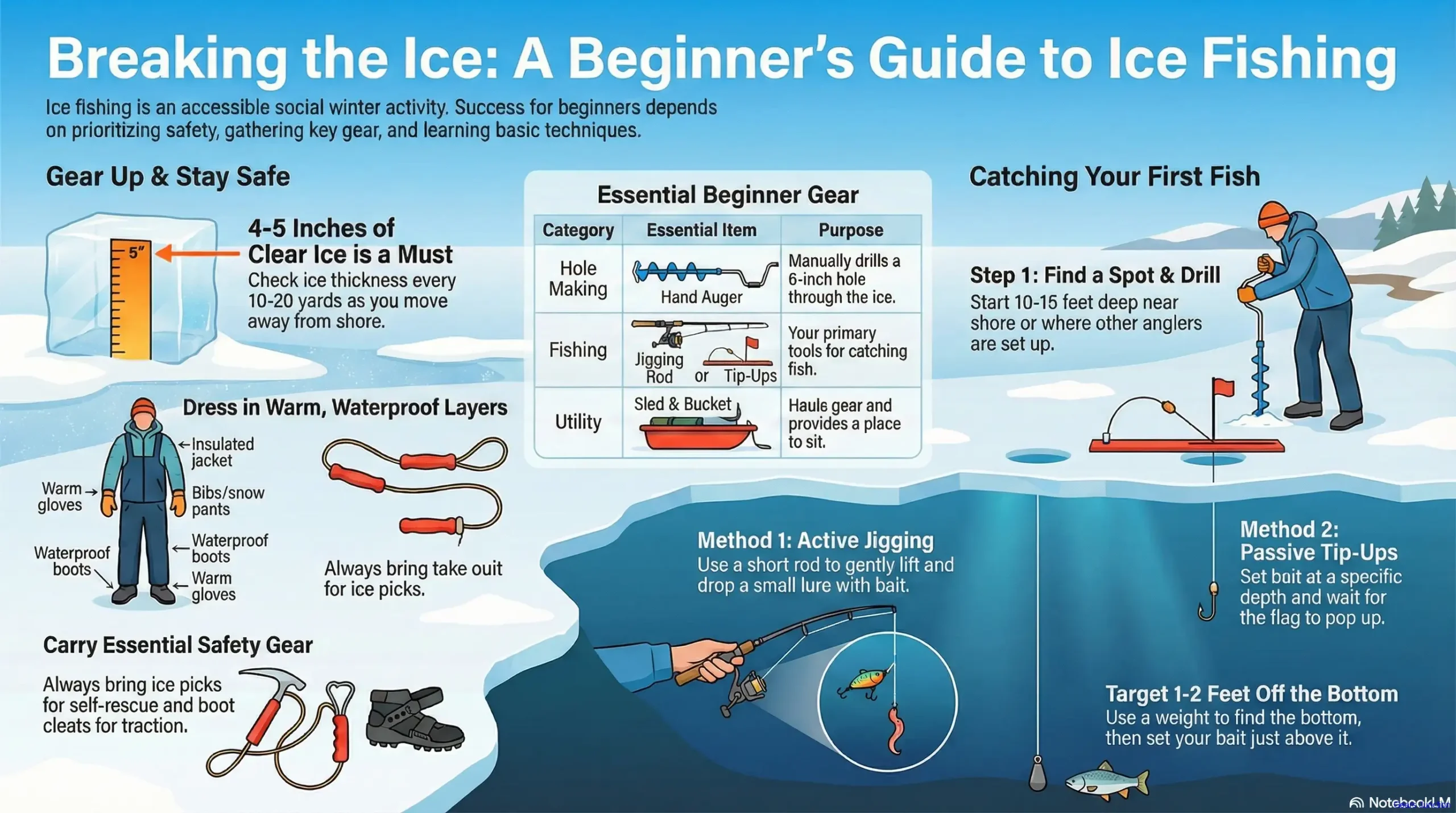
Safety is the most critical aspect of ice fishing, as conditions can change rapidly.
- Ice Thickness and Testing: You should never assume ice is safe just because others are on it. A minimum of 4 inches of solid, clear ice is generally required for walking, though some experts recommend 5 inches to be safe. Use an auger or a chisel to intermittently check thickness as you move away from the shore.
- Personal Safety Gear: Always wear ice picks or safety spikes around your neck; these are essential for pulling yourself back onto the ice if you fall through. Cleats or traction spikes should be attached to your boots to prevent slips and falls on slick surfaces.
- Flotation and Buddy System: Wearing floating bibs or a life jacket is highly recommended, especially when checking “first ice”. Furthermore, you should never fish alone and should always carry a long length of heavy rope for emergencies.
- Preparation: Before heading out, check the weather forecast and ensure you have a valid fishing license, as regulations regarding bait and the number of lines allowed can vary by lake.
Fundamental Fishing Equipment
While you can spend thousands on high-end gear, beginners only need a few core items to get started.
- The Auger: This tool is used to drill holes through the ice. Hand augers are the most economical choice and provide a good workout, while power augers (gas or battery-operated) are much faster and easier when dealing with thick ice or drilling many holes.
- Rods and Reels: Ice fishing rods are much shorter than regular rods to allow you to stand directly over the hole. For smaller species like bluegill or crappie, use light (L) or ultralight (UL) rods; for larger fish like walleye, medium-light (ML) or medium (M) rods are better.
- Tip-Ups: These are stationary devices that sit over the hole. When a fish takes the bait, a brightly colored flag pops up, allowing you to monitor multiple locations at once.
- Tackle and Bait: Common lures include jigs (tungsten or micro) and spoons like the Swedish Pimple. These are often “tipped” with live bait such as wax worms, spikes (maggots), or minnows.
- Electronics: While not strictly essential for beginners, a flasher or fish finder (such as a Vexilar or Marcum) helps you see fish under the ice and understand how they are reacting to your lure.
Clothing and Comfort
Staying warm is a matter of safety as much as comfort, as a cold day can quickly turn dangerous.
- Layering: Wear a moisture-wicking base layer, an insulated mid-layer, and a waterproof, wind-blocking outer shell or bibs.
- Extremities: Use insulated waterproof boots, warm socks (bring extras in case they get wet), and waterproof mittens or gloves. A hat and neck gator are also vital for heat retention.
- Shelter and Heat: A portable pop-up hub or flip-over shelter provides a reprieve from the wind. Inside, a small propane heater (like a Big Buddy heater) can keep the area warm, though safety must be prioritized to prevent carbon monoxide buildup.
- Transportation: A sled is essential for hauling all your gear, and a 5-gallon bucket serves as both a carrier for tackle and a convenient seat.
Think of the ice as a heavy security door between you and the fish; the auger is your key to opening that door, but your safety gear—like picks and cleats—is the insurance that keeps the door from accidentally trapping you on the wrong side.
Conclusion: Ready for the Hard Water?
So, the next time you drive past a frozen lake dotted with distant figures, you’ll know the real story. You’ll see it not as a lonely landscape, but as an invitation to a secret world hidden in plain sight—a world of roaring laughter, scientific precision, and heart-pounding sprints across the ice. It’s a vibrant, thriving culture that comes alive when the world freezes over.
Now that you know the real story behind the sport, what’s the most surprising thing you learned about life on the ice?